Is It Good to Exercise During Your Period? Should You Change Your Workout?
Yes, for most women, it is good to exercise during your period. You can generally continue walking, cardio, strength training, and other normal exercise while menstruating. You may want to adjust the intensity or duration if you're experiencing cramps, fatigue, heavy bleeding, or other uncomfortable symptoms.
Your period starts, the cramps kick in, your energy drops, and suddenly that workout you planned doesn't sound nearly as appealing.
So, is it good to exercise during your period, or should you give yourself a few days off?
For most women, there's no reason to automatically stop exercising because your period starts. In fact, physical activity may help with some of the symptoms that make you want to skip your workout in the first place. The bigger question isn't necessarily whether you should exercise. It's whether you need to change how you exercise based on how you're feeling.
Key Takeaways
Yes, it is generally safe and beneficial to exercise during your period.
Research has not found that menstruation significantly reduces most women's overall ability to exercise.
Various exercises may help relieve menstrual symptoms, including cramps, fatigue, and mood changes.
You don't automatically need a lighter workout simply because you're on your period.
Your symptoms matter. If you're exhausted, uncomfortable, or in pain, adjusting your workout is completely reasonable.
Walking, cardio, strength training, stretching, and other forms of movement can all fit into your routine during your period.

Is It Good to Exercise During Your Period?
For most women, yes, it is good to exercise during your period. The U.S. Office on Women's Health specifically addresses this question and says women can exercise while menstruating. More importantly, researchers haven't found evidence that the menstrual cycle significantly changes a woman's general ability to exercise.
That's worth emphasizing because women receive a lot of conflicting fitness advice surrounding their cycles.
You may have heard that you shouldn't lift heavy during your period, need to avoid intense exercise, or should completely change your training program depending on which phase of your menstrual cycle you're in.
The reality is more individual.
Hormonal changes throughout your menstrual cycle can influence how you feel. Your energy may be different. You might have cramps, bloating, headaches, fatigue, or other symptoms. But having your period doesn't automatically mean your body can't do your normal workout.
Some women feel great and train as usual. Others want to dial things back for a day or two. Both are okay.
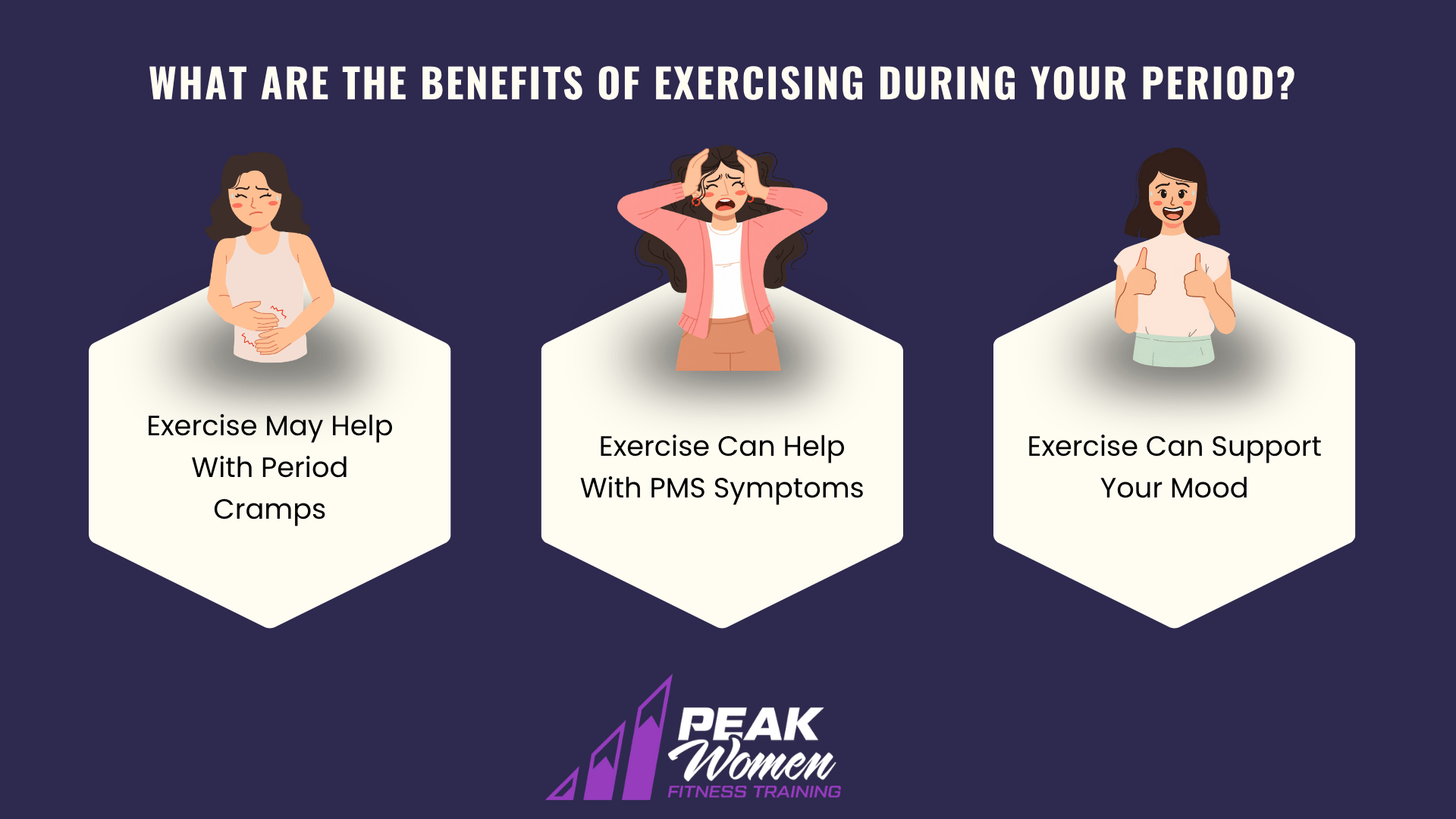
What Are the Benefits of Exercising During Your Period?
You don't lose the physical and mental benefits of exercise when your period begins. Staying active may actually help you manage some menstrual symptoms.
Exercise May Help With Period Cramps
When you're curled up with cramps, working out may be the last thing you feel like doing. But movement may actually help.
Reports have found that women who exercise regularly experience fewer painful menstrual cramps.
More recent research supports the potential benefit as well. A 2025 randomized controlled trial studied women ages 18 to 45 experiencing menstrual symptoms. The exercise group followed a program that included moderate-intensity walking, plus strengthening, flexibility, and balance exercises, over about 12 weeks.
Researchers found significant improvements in menstrual symptoms and sleep quality among the exercise group.
That doesn't mean one workout will magically make your cramps disappear. But it does give us another reason to view regular movement as something that may help during your period, rather than something you automatically need to avoid.
Exercise Can Help With PMS Symptoms
The benefits may start before your period does.
Regular aerobic activity throughout the month may help improve PMS symptoms such as fatigue, difficulty concentrating, and depression.
That matters because sometimes the hardest part of working out isn't your actual period. It's the days leading up to it when you're tired, irritable, uncomfortable, or simply don't feel like yourself.
Movement doesn't have to mean pushing yourself through the hardest workout of your week. A walk, strength session, bike ride, or another activity you enjoy still counts.
Exercise Can Support Your Mood
Hormonal fluctuations throughout your menstrual cycle can affect more than your physical symptoms. They can influence your emotional and mental well-being, too.
Exercise has well-established benefits for mental health, sleep, and overall well-being. Those benefits don't disappear because you're menstruating.
If you're dealing with irritability, low energy, or just feeling "blah," moving your body may be exactly what you need, even if today's workout looks different from yesterday's.
Should I Change How I Workout During My Period?
Maybe. But you don't need to change your workout just because the calendar says you should. This is where women's fitness advice sometimes gets unnecessarily complicated.
Your menstrual cycle can affect your energy. Estrogen and progesterone are at their lowest at the beginning of your period and gradually begin to rise. Some women report lower energy during their periods, while others actually have more energy than usual.
Researchers haven't found significant differences across the menstrual cycle in women's overall ability to exercise. One notable exception involves prolonged endurance exercise: exercising after ovulation but before menstruation may be harder in hot, humid conditions.
For the average woman heading into Peak Women for a strength workout, however, your period doesn't automatically require an entirely different training plan.
Instead, pay attention to your body.
How to Choose Your Period Workout
There's no single "best" workout during your period. Use how you feel that day to decide whether to train normally or make an adjustment.
| Workout | Good Option When... | How You Can Adjust | Examples |
|---|---|---|---|
| Strength Training | You feel strong and comfortable | Reduce weight, sets, or intensity if needed | Squats, rows, presses, deadlifts |
| Walking & Light Cardio | You have lower energy or want gentler movement | Slow your pace or shorten your workout | Walking, cycling, swimming |
| Regular Cardio | Your energy feels normal | Continue normally or reduce intensity based on symptoms | Running, cycling, elliptical |
| Mobility & Stretching | You're dealing with cramps, stiffness, or fatigue | Keep movement gentle and comfortable | Stretching, yoga, mobility work |
| Rest & Recovery | Pain, nausea, dizziness, or unusual fatigue make exercise uncomfortable | Take the day off and return when you feel better | Rest, hydration, recovery |
Strength Training
Good Option When...
You feel strong and comfortable.
How You Can Adjust
Reduce weight, sets, or intensity if needed.
Examples
Squats, rows, presses, deadlifts.
Walking & Light Cardio
Good Option When...
You have lower energy or want gentler movement.
How You Can Adjust
Slow your pace or shorten your workout.
Examples
Walking, cycling, swimming.
Regular Cardio
Good Option When...
Your energy feels normal.
How You Can Adjust
Continue normally or reduce intensity based on symptoms.
Examples
Running, cycling, elliptical.
Mobility & Stretching
Good Option When...
You're dealing with cramps, stiffness, or fatigue.
How You Can Adjust
Keep movement gentle and comfortable.
Examples
Stretching, yoga, mobility work.
Rest & Recovery
Good Option When...
Pain, nausea, dizziness, or unusual fatigue make exercise uncomfortable.
How You Can Adjust
Take the day off and return when you feel better.
Examples
Rest, hydration, recovery.
What Are the Best Workouts to Do During Your Period?
There isn't one universally "best" period workout.
That's another reason we don't love rigid rules telling women they must do yoga during one phase, lift heavy during another, and avoid certain exercises during another.
Your best workout is one that feels appropriate for your symptoms, your goals, and your body that day.
Walking and Light Cardio
Walking is one of the easiest options when you want to move without committing to a demanding workout.
You control the pace and duration, and you don't need special equipment. Light cycling, swimming, jogging, or other forms of cardio can work, too.
If you're feeling more fatigued than usual, shorten the workout or decrease the intensity.
Strength Training
Yes, you can strength train during your period!
There isn't a blanket rule saying women need to put down the weights once menstruation begins.
If you feel strong and comfortable, you may be able to complete your regular strength workout. If you're experiencing fatigue, cramping, or discomfort, you and your trainer can modify the workout accordingly.
That's one benefit of personalized training: the program can respond to the person in front of us rather than follow an arbitrary rule.
Stretching, Mobility, and Gentle Movement
Sometimes you just don't want an intense workout.
Gentle stretching, mobility work, yoga, or other lower-intensity movement can be a good option when you're dealing with cramps, fatigue, or general discomfort.
And remember: choosing an easier workout because you genuinely need one isn't the same thing as deciding women shouldn't train hard during their periods.
Do You Need to "Cycle Sync" Your Workouts?
This is where things get interesting.
Cycle syncing has become increasingly popular online, with workout recommendations sometimes prescribing specific types or intensities of exercise for each phase of the menstrual cycle.
There is some logic behind paying attention to your cycle. Hormone levels change throughout the month, and your energy and symptoms may change along with them.
But that doesn't mean every woman needs a rigid four-phase workout calendar.
The Office on Women's Health notes that researchers have not found significant differences in women's general ability to exercise throughout the menstrual cycle.
Individual variation is also tremendous.
Instead of assuming you'll perform poorly because an app says you're in a certain phase, start noticing your own patterns.
Do you consistently feel exhausted on the first day of your period? Does your energy improve after a couple of days? Do you experience cramps but otherwise feel strong? Do you notice no difference whatsoever?
Tracking your period alongside your workouts can help you identify those patterns over several months. That's information you can actually use.
When Should You Avoid or Modify Exercise During Your Period?
There's a big difference between saying, "Women shouldn't exercise hard during their periods," and saying, "Sometimes your symptoms are telling you to back off."
If you feel unusually fatigued, nauseated, dizzy, or experience increasing pain or discomfort during exercise, stop and give your body the recovery it needs.
You should also pay attention to changes in your menstrual cycle itself.
Excessive exercise can contribute to irregular or missed periods. The Office on Women's Health recommends talking with a healthcare professional if your periods become irregular or stop, particularly because menstrual changes can sometimes signal that your body isn't getting the energy it needs.
Severe menstrual pain or bleeding that interferes with work, school, exercise, or normal activities also shouldn't simply be dismissed as something you have to endure.
Your Period Doesn't Need to Control Your Workout
So, is it good to exercise during your period?
For most women, absolutely.
Your period isn't an automatic rest week, and you don't need to be afraid of strength training, cardio, or maintaining your normal routine simply because you're menstruating.
But you also don't have to prove anything.
Some months you may feel strong enough to train exactly as usual. Other months, cramps, fatigue, headaches, or heavier bleeding may make you want to scale things back.
Good training leaves room for both.
At Peak Women in Troy, Michigan, that's part of what we mean when we say personal training should actually be personal. Women's bodies change—not only throughout the menstrual cycle, but through pregnancy, postpartum recovery, perimenopause, menopause, and different stages of life.
Your workouts should be able to change with you.
Listen to your body, work with it instead of against it, and keep moving in whatever way feels right for you.
Ready for a fitness program built around you? Reach out to Peak Women today for your free consultation and first workout.
Frequently Asked Questions
Is it good to exercise during your period on the first day?
Yes, you can exercise on the first day of your period if you feel comfortable. Some women experience heavier bleeding, cramps, or fatigue during the first day or two and may prefer a lighter workout, while others can continue their normal routine.
Is it okay to lift weights during your period?
Yes. You don't automatically need to stop strength training or lifting weights because you're menstruating. Adjust your intensity if you're experiencing fatigue, pain, or other symptoms that make your normal workout uncomfortable.
Can exercise make period cramps better?
It may. Research suggests regular physical activity may help some women experience fewer or less severe menstrual symptoms, including painful cramps.
Should I do a lighter workout during my period?
Only if you need one. If you feel good, you may be able to maintain your usual workout. If you're experiencing fatigue, cramps, nausea, or discomfort, reducing your workout's intensity or duration may feel better.
Should my workouts change throughout my menstrual cycle?
Not necessarily. Hormonal fluctuations can affect energy and symptoms, but research hasn't established that all women need to train according to specific menstrual-cycle phases. Tracking how you feel and perform throughout your cycle can be more useful than following a rigid schedule.